Farewell, Eva Marie Saint

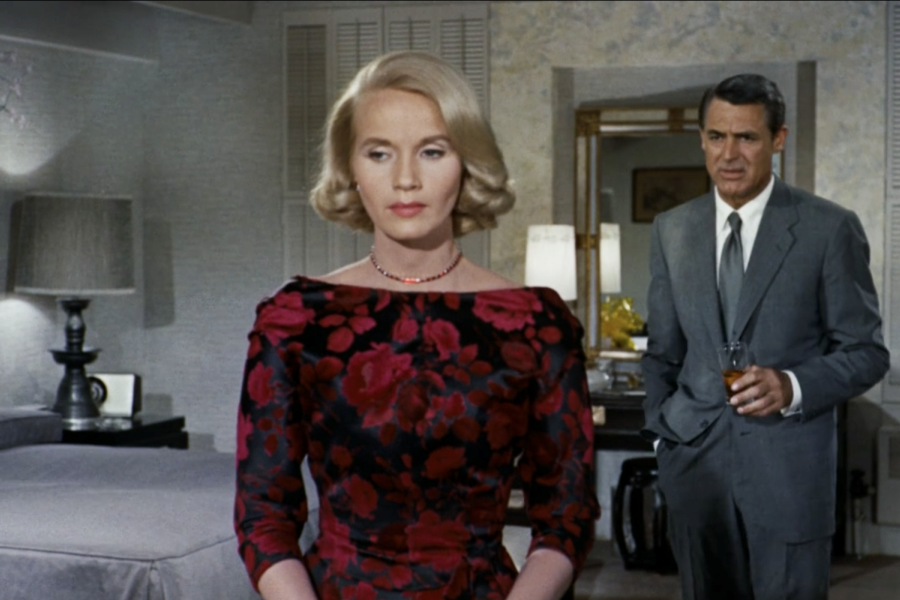
Photo caption: Eva Marie Saint in NORTH BY NORTHWEST.

Eva Marie Saint, who was essential to some of the greatest movies ever, has died at age 102. She was an actress of uncommon versatility and depth, whose delicate beauty was most precisely described by the NYT as luminous.

I’ll always remember Eva Marie Saint for one of the sexiest movie scenes of all time, in North By Northwest, when she propositions Cary Grant in the dining car of a moving train. She won her Oscar for On the Waterfront, imbuing what could have been an unmemorable Good Girl role with passion and agency, and matching up with the charisma of Marlon Brando. Her talents extended to comedy, and she was wonderful in one of my personal favorites, the Cold War satire The Russians Are Coming! The Russians Are Coming!

Prioritizing a balanced family life, she made many fewer movies than she could have, but, along with Brando and Grant, she co-starred with Paul Newman, Montgomery Clift, Warren Beatty, Bob Hope, Carl Reiner, and Gregory Peck in the movies and with Jack Lemmon on the stage.

Eva Marie Saint and Cary Grant in NORTH BY NORTHWEST.

DEAD SOULS: absurdity rides in the West, but it’s not funny enough

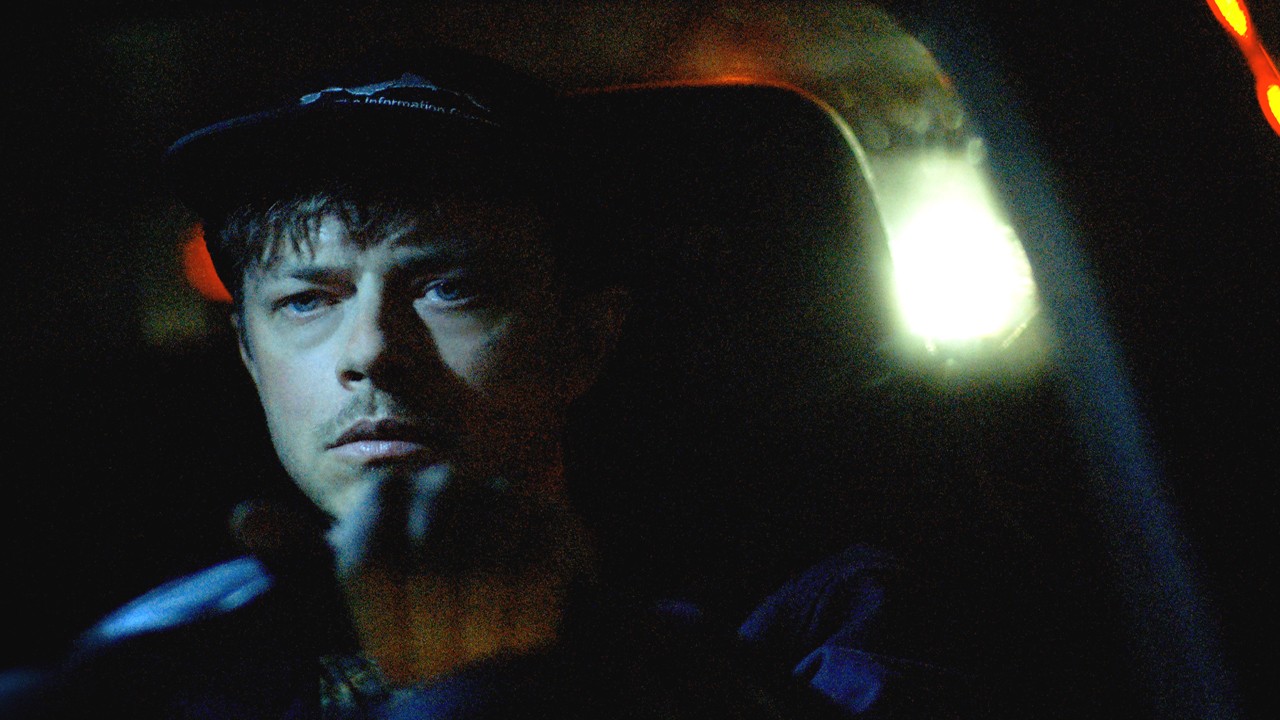
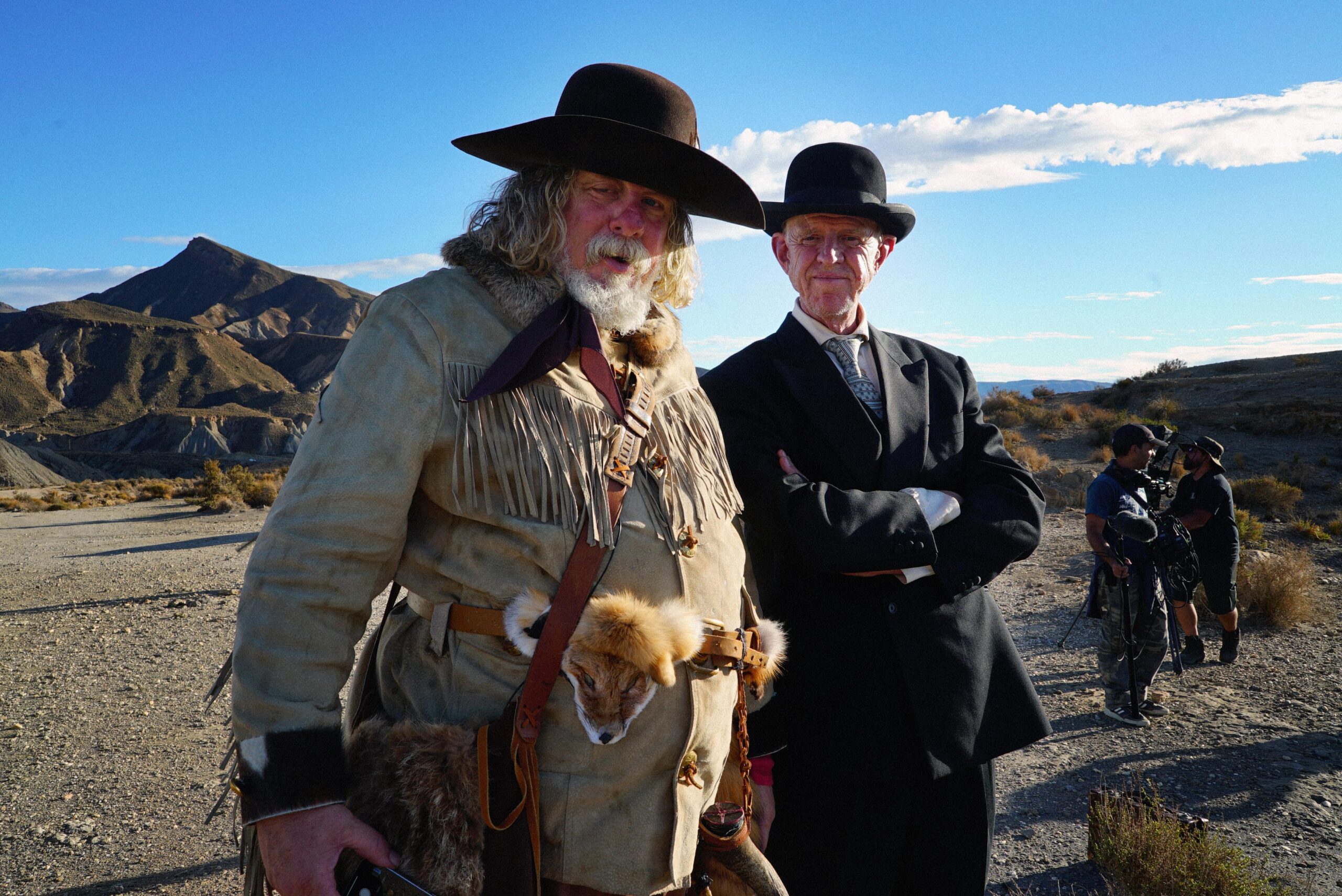
Photo caption: Zander Schloss and Alex Cox in DEAD SOULS. Courtesy of Kino Lorber.

The absurdist Western comedy Dead Souls begins with a solitary stranger walking the desert we’ve seen in spaghetti westerns. That reference is intentional, because director Alex Cox filmed Dead Souls near Almeria, Spain, in the Andalusian expanse used repeatedly by Sergio Leone. But we see right away that Dead Souls is more parody than spaghetti western – with the hotel clerk’s exaggerated twitching and the mayor sporting massive sideburns, each the size of Angela Davis’ Afro.

The stranger (played by Cox himself) is named Strindler, and his purpose is mysterious. He is up to something, and the locals can’t figure out what it is, even when they see him buying something of no apparent value.

We see the familiar western tropes, from the poker game in the saloon to the gunfight in the dusty street. There are homages to A Fistful of Dollars, High Plains Drifter, The Man Who Shot Liberty Valance and even Greaser’s Palace.

Strindler is guided around the ranches and mines by the town drunkard (Zander Schloss), whose sense of his own nickname is very funny. There’s a clever running gag whenever Strindler is asked if he has played poker, ridden a horse or fired a pistol. And there’s an outrageous pun on the name Strindler.

It turns out that Strindler’s scheme would monetize American institutional racism. And that’s what Dead Souls is ultimately about – mocking the hardwired, guileless, shameless, open racism of America’s 19th century, that leaks into the present. Dead Souls even takes us into the Trump version of ICE, which I didn’t find funny; (maybe Too Soon?)

In 1994, writer-director Alex Cox made one of the all-time great cult movies – Repo Man. He followed that with the arthouse hit Sid and Nancy, and not much since that I recognize.

There’s a famous scene with Cleavon Little in Blazing Saddles that made us laugh at outrageously racist characters – and I think it still works. But Dead Souls beats that dead horse too repeatedly. I found the absurdity amusing, but the entirety of Dead Souls just isn’t funny enough..

Dead Souls is streaming on Amazon, AppleTV and Fandango.

THE MARCHING BAND: an emotionally powerful Feel Good

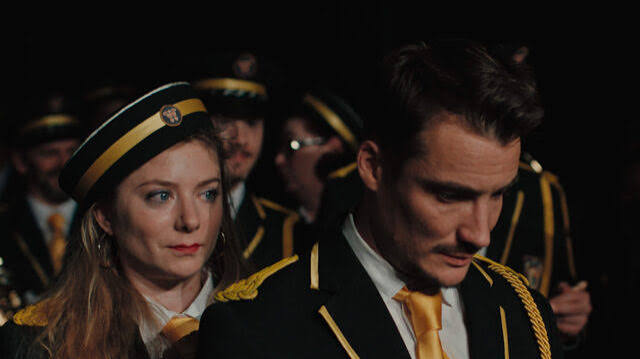
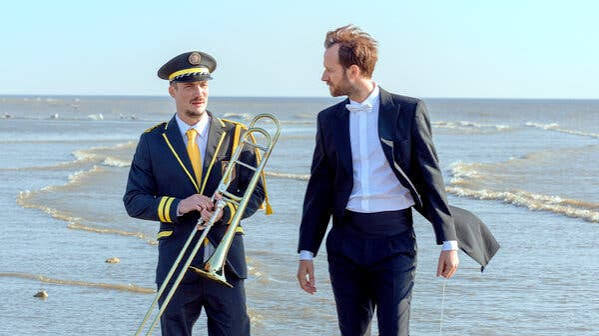
Photo caption: Pierre Lottin and Benjamin Lavernhe in THE MARCHING BAND. Courtesy of Greenwich Entertainment.

Surprisingly emotionally powerful for a Feel Good movie, the French dramedy The Marching Band weaves together Odd Couple and underdog stories. Thibaut (Benjamin Lavernhe) is an orchestra conductor of global celebrity, who has leukemia and requires a bone marrow transplant; his sister undergoes a compatibility test, and Thibault learns that she isn’t his biological sister. He is stunned to learn that, as an infant, he was given up for adoption by a woman who already had a toddler son.

Thibault arrives in a downtrodden mining town to track down his biological brother Jimmy (Pierre Lottin). Jimmy turns out to be a working class divorced dad, earning 11 Euros an hour slinging hash at a factory cafeteria. Rough-around-the-edges Jimmy is cool toward the cultured Thibault, he but he relents to donate the bone marrow.

Months later, Thibault is in remission, and he returns to Jimmy’s town to thank him again. Thibault is surprised to find Jimmy is the trombonist in the town’s marching band. Jimmy wants little to do with Thibault for two reasons. First, he reminds Jimmy of their neglectful mother, towards whom Jimmy only feels rage and contempt. Second, having always experienced poverty, he is jealous of all the advantages that Thibault has been given by the adoptive family.

At Jimmy’s modest flat, Thibault is wowed by Jimmy’s impressive collection of jazz vinyl. Thibault sees what Jimmy himself doesn’t – Jimmy has perfect pitch, innate musical taste and some talent as a musician. Even with their shared musical interests, Jimmy resists getting closer to Thibault, but Jimmy’s bandmates embrace Thibault’s celebrity.

The marching band is getting ready for a regional competition, which is a welcome distraction for the entire community. The factory is the town’s biggest remaining employer, and unseen corporate interests are threatening to close it. This being France, the workers are responding with labor strife, and everyone is suffering anxiety and dread. And, now, the marching band loses its conductor.

Now, here’s the key to The Marching Band’s success. At this point, director Emmanuel Courcol and his co-writers Irène Muscari and Oriane Bonduel could have gone corny. They could have had Thibaut conduct the band to win the competition, save the factory and live happily ever after with Jimmy. Instead, the complications of our real world intrude, and the story heads to a much more emotionally powerful conclusion. The Marching Band finds it way to a profound expression of love without sentimentality.

Lavernhe and Lottin are excellent, as is Sarah Suco as Sarah, a local activist/trumpet player who likes Jimmy. Lavernhe and Suco were nominated for César Awards (the French Oscar).

One of the top grossing recent French films at the French box office, The Marching Band was nominated for seven César Awards.

The Marching Band is a real audience pleaser, and it’s streaming on Amazon and AppleTV.

JOHN BOORMAN AND THE DEVIL: anatomy of a fiasco

Photo caption: Linda Blair in JOHN BOORMAN AND THE DEVIL. Courtesy of Yellow Veil Pictures.

John Boorman and the Devil tells the true story of an all-time movie-making fiasco – and it’s more entertaining than the original film could have ever hoped to be. That 1977 bomb was The Exorcist II: The Heretic, which I correctly judged at the time to unfathomably bad. In John Boorman and the Devil, Boorman and his collaborators explain, in their own words, what happened.

The Exorcist became a monster hit in 1973, making an unexpected fortune for Warner Bros. The studio, seeing others profit with Exorcist ripoffs, wanted to cash in with a genuine Exorcist sequel. Trouble was, both The Exorcist’s director William Friedkin and writer Peter Blatty felt cheated by Warners and were embroiled in bitter litigation.

The studio courted director John Boorman, who was at his height of marketability, having just made Point Blank and Deliverance, two great films that have since been added to the National Film Registry. Boorman, however, was bored by the idea of making a horror movie; instead, he wanted to make a trippy art movie, as he had with Zardoz. Unfortunately, Boorman’s vision, as reflected in the continually rewritten screenplay by Rospo Pallenburg, manifested itself as incoherent cinema. (I remember being completely puzzled as I watched Max Von Stdow wandering through an Ethiopian desert,)

Of course, the target audience for the film was the folks who had enjoyed The Exorcist. Because The Exorcist was a horror movie, they were understandably expecting Exorcist II would be another horror movie. Disappointed by the lack of horror, confused and bored, Exorcist II: The Heretic was greeted with hostility. and then ridicule, and finally laughed off the nation’s movie screens.

John Boorman in JOHN BOORMAN AND THE DEVIL. Courtesy of Yellow Veil Pictures.

In John Boorman and the Devil, director David Kittredge brings us interviews with Boorman himself, stars Linda Blair and Louise Fletcher, the screenwriter, the assistant directors, a camera operator and the script supervisor. We even hear from the biologist in charge of wrangling the thousands of locusts. Boorman is a good sport and reflects on his biggest personal disaster with a minimum of defensiveness or self-pity. Blair and Fletcher are delightful raconteurs.

It didn’t help that Exorcist II: The Heretic is filled with unintentionally funny moments. At one point, Linda Blair tap dances. Wearing an African tribal headdress, James Earl Jones spits out a whole tomato. Even today, Blair and Fletcher burst out laughing at the name of the movie’s demon – Pazuzu.

Boorman dryly recounts advice he received from the great director David Lean: “Everybody makes failures. Just don’t make a famous one.”

I had heard William Friedkin taking delight in a hilarious anecdote about a disastrous Pasadena test screening of Exorcist II. Because Friedkin wished the sequel and its studio ill, I had presumed that he had embellished the incident – but John Boorman and the Devil brings an eyewitness who corroborates Friedkin’s version.

And here’s another tidbit – Boorman wanted to cast then emerging star Christopher Walken, but the studio insisted on big name Richard Burton. Burton turned in a one-dimensional performance, relying on his majestic voice and gravitas and little else.

John Boorman and the Devil is streaming on Amazon, AppleTV and Fandango. On October 9, Turner Classic Movies is showing John Boorman and the Devil in a double feature with Exorcist II: The Heretic; watch the first and skip thr second.

Movies to See Right Now

Photo caption: John Malkovich and Sam Rockwell in WILD HORSE NINE, opening the Mill Valley Film Festival. Courtesy of Mill Valley Film Festival.

This week on The Movie Gourmet – my preview of the Mill Valley Film Festival, which just opened and runs through October. Every year, most of the big Oscar movies play at Mill Valley before their thetrical rekease. This year’s program includes films by many of the world’s filmmakers: Cristian Mungiu,  Ryûsuke Hamaguchi, Hirokazu Koreeda, Pedro Almodovar, Mike Leigh, Andrey Zvyagintsev, Pawel Pawlikowski, Peter Farrely, Danny Boyle, Martin McDonagh, Barbara Kopple and Ron Howard. The fest opened with Boyle’s dark comedy Wild Horse Nine with John Malkovich and Sam Rockwell as CIA agents on Easter Island.

I also posted a new review of the observational indie dramedy The Scout, which is worth seeking out in art houses.

REMEMBRANCE

Fashion designer Bob Mackie dominated the Hollywood red carpet, adorning clients like Cher, Carol Burnett, Bernadette Peters, and Mitzi Gaynor. I saw Bob Mackie: Naked Illusion at a SLO Film Fest screening, with Bob Mackie in person.

CURRENT MOVIES

ON TV

Julie Delpy in WHITE.

On October 5, Turner Classic Movies brings us two of Kzrysztof Kieslowski’ Three Colours trilogy which I include on my Greatest Movies of All Time. The first is Blue, starring Juliette Binoche as a woman who battles overwhelming grief by de-linking herself from all aspects of her previous life; nevertheless, some elements of her past intrude, and sh come to a complicated path forward. Because of the character’s heartbreak, most of Blue is pretty grim. I recommend that you first sample White, about a Polish immigrant who stands to get kicked out of France when his French wife (Julie Delpy) decodes to divorce him.

Oddly, TCM is not playing Red, perhaps the best of the three films, starring Irene Jacob and Jean-Louis Trintignat as two of several Parisians connected by chance and dog welfare. As the various characters thread teir ways through various sexual improprieties, including a voyeurism scandal, the final scene connects them with the protagonists of Blue and White. Red is included with Criterion and HBO and available to rent on Amazon, AppleTV, YouTube and Fandango.

The Polish auteur Kieslowski spent most of his career behind the Iron Curtain and topped off his career with five great, French-funded projects from 1989 to 1994: Dekalog, The Double Life of Veronique, Blue, White and Red. After finishing Red at age 52, he retired at the peak of his powers, and, sadly, died less than two years later during heart surgery.

THE SCOUT: not what she signed up for

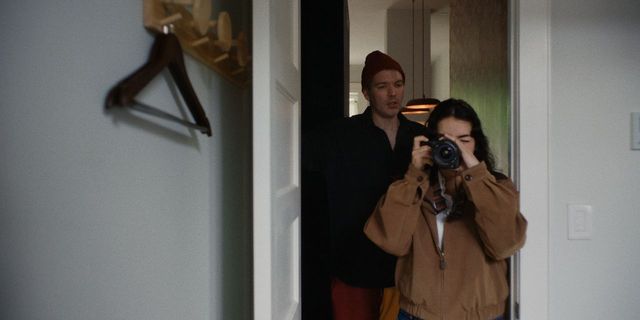
Photo caption: Mimi Davila in THE SCOUT. Courtesy of Greenwich Entertainment.

In the observational indie dramedy The Scout, Sofia (Mimi Davila) is a movie location scout, racing around NYC to find shooting locations for the pilot of a TV episodic series. That means that, all day, she meets new people, some of whom reveal discontent in their own personal lives. That also means that her frenetic work life doesn’t leave her the time or space to reflect on her own life.

Sofia’s job is to coax complete strangers into letting a film crew take over their home, she needs to build some level of trust with them. Many share the dissatisfaction with their own personal situations. The first is a woman who has successfully raised children who are living their own lives far away from her. The second is a guy bewildered by his recently becoming a stay-at-home dad; “My life is basically over,”

We are our choices. Everyone Sofia meets seems to be asking “how did life turn out this way?, a question Sofia finally poses to herself.

Sofia encounters a home owner who was once a close gal pal. It looks like she’s rediscovered a rewarding human connection, but a job fiasco intervenes. Exhausted, highly pressured and gritting her way an avalanche of indignities, Sofia finally takes a moment to take stock of her own life.

Max Rosen and Mimi Davila in THE SCOUT. Courtesy of Greenwich Entertainment.

The Scout is the first feature from writer-director Paula González-Nasser, who drew upon her own six years as a location scout. González-Nasser proves herself a keen observer of human nature. The Scout is essentially a theme braided into a series of vignettes and , González-Nasser’s construction of the story and its pacing are excellent.

Sofia is trying to satisfy the whims of a movie crew that generates plenty of droll humor, especially for their outrageous disrespect of the people who are offering their homes (“that’s an ugly door“). We cringe as the all-white creative team, every one of whom is surely on the political left, lapses into the most clueless ethnic stereotyping. They’re as serious as if they’re making Hamnet, but the pilot itself is clearly formulaic crap. (The guy who owns the fish store is pretty funny, too.)

The Scout earned buzz at its Tribeca premiere. Having opened this past weekend in New York, The Scout in rolling out more widely in theaters, beginning with the DTLA Alamo Drafthouse on Friday.

MILL VALLEY FILM FESTIVAL: see ’em here first

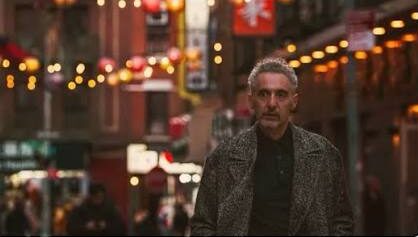
Photo caption: John Tuturro in THE ONLY LIVING PICKPOCKET IN NEW YORK, Courtesy of Mill Valley Film Festival.

The Mill Valley Film Festival is always the best opportunity for Bay Area film goers to catch an early look at the Big Movies – the prestige films that will be released during Award Season. MVFF49 begins on October 1 and runs through October 11. Today I’m revealing my choice for the under-the-radar Must See at the festival. But first, let’s look at the most likely audience-pleasers:

  • Wild Horse Nine: The opening night film from director Martin McDonagh (In Bruges, Three Billboards Outside Ebbing, Missouri) unleashes John Malkovich and Sam Rockwell as CIA agents on Easter Island before Chile’s 1973 Pinochet coup. Just for good measure, the cast includes Steve Buscemi, Parker Posey and Tom Waits.
  • I Play Rocky: The most Rocky of real life Rocky stories – unknown actor Sylvester Stallone refuses to sell his sure-fire winner of a screenplay unless he is cast in the lead role. From director Peter Farrely (Green Book).
  • Paper Tiger: James Gray, who single-handedly revived the historical adventure epic with The Lost City of Z, delivers a crime thriller with Adam Driver, Scarlett Johansson and Miles Teller, Premiered at Cannes.
  • Ink: Jack O.Connell plays Larry Lamb, the editor whose trashy sensationalism made Rupert Murdoch (Guy Pearce) the titan of tabloids. Director Danny Boyle (Trainspotting, 127 Hours, 28 Days Later) critiques both Murdoch and Britain’s posh snoots.

And, now, let’s go high-brow. MVFF49 has assembled an astonishing showcase of films by the world’s greatest directors.

  • Fjord: Let’s start with the Palm d’Or winner at Cannes.  With a family’s unity at risk, cultures clash in this psychological drama from Romanian auteur Cristian Mungiu (4 months, 3 Weeks and 2 Days). Romania’s official submission for the Best International Feature Oscar.
  • All of a Sudden:   Another intimate drama from Ryûsuke Hamaguchi (Drive My Car)  Premiered at Cannes. Japan’s official submission for the Best International Feature Oscar.
  • Minotaur:   From exiled Russian auteur Andrey Zvyagintsev (The Return, Leviathan). Premiered at Cannes. France’s official submission for the Best International Feature Oscar.
  • Bitter Christmas: Pedro Almodovar explores the ethics of turning someone else’s life into art. Played at Cannes.
  • Tender Loving Care: Sure to be another piercing glimpse into human behavior by British cinema icon Mike Leigh (Naked, Secrets & Lies, Topsy-Turvy, Vera Drake, Happy-Go-Lucky, Another Year).
  • Fatherland   Pawel Pawlikowski (the Oscar-winning Ida) takes on Thomas Mann’s return to a post-war Berlin. Sandra Huller stars. Premiered at Cannes. Poland’s official submission for the Best International Feature Oscar.
  • Look Back  The latest from Hirokazu Koreeda (Shoplifters, Broker).
Suzanne Gerin in LA GRADIVA. Courtesy of MVFF.

And here are two acclaimed films from emerging directors:

  • La Bola Negra:  This exploration of gay identity over the decades from the Spanish filmmaking partners Los Javis just won the People’s Choice Award at Toronto. Premiered at Cannes and purchased by Neyflix. Spain’s official submission for the Best International Feature Oscar.
  • La Gradiva: The directorial debut from cinematographer Marine Atlan follows a French high class on a trip to Naples and Pompeii. Hormones rage, and so does teen angst, as Atlan guides her non-professional cast to the emotionally powerful ending.  I’ve screened it, and every moment is authentic. Premiered at Cannes.

But don’t overlook one of the best films of 2026 – The Only Living Pickpocket in new York with its gripping, perhaps career-topping, performance by John Tuturro. In his third feature, writer-director Noah Segan, a prolific actor and protege of Rian Johnson, has created a portrait of a man who has evaded all of life’s responsibilities except one, and now finds himself desperate, not for survival, but for redemption. The performances by Tuturro and Tatiana Maslany (Orphan Black, She-Hulk in the Marvel Universe) are award-worthy, and the cast includes Giancarlo Esposito, Steve Buscemi, Will Price, and Jamie Lee Curtis. Don’t miss this one.

And there’s more, including films from Ron Howard and Barbara Kopple, movies starring Helen Mirren, Juliette Binoche, Javier Bardem and Penelope Cruz, a personal appearance by Lea Seydoux and a Nigerian version of Mrs. Dalloway. Peruse the MVFF49 program. Here’s the festival trailer.

Movies to See Right Now

Photo caption: Antonio Banderas and Dominic Sesso in TONY: Courtesy of A24.

This week on The Movie Gourmet, a new review of the comic documentary The History of Concrete and recommendations at this year’s Nashville Film Festival. Don’t overlook my recommendations from last week – David Fortune’s emotionally powerful debut Color Book and the gripping doc Sweetheart Deal, a triumph of cinéma vérité; both are available to stream.

CURRENT MOVIES

ON TV

Robert Newton and Sally Gray in OBSESSION

“And the manner in which I dispose of your body presents no obstacles.”

So says Dr. Clive Riordan (Robert Newton), an especially diabolical and chilling movie villain, in The Obsession (The Hidden Room) coming up on October 1 on Turner Classic Movies. 1949

Riordan, a twisted psychiatrist, is addressing his wife’s American lover, Bill Kronin (Phil Brown). Riordan is addressing the infidelity of his wife Storm (Sally Gray) by kidnapping Kronin and hiding him, chained to the wall of a soundproof room behind his garage. Planning the perfect crime, Riordan intends to hold Kronin for months, until the police cease looking for him; then, Riordan intends to dissolve Kronin in a bath of acid. Riordan sadistically explains all of this to his victim, and the plan does look foolproof – but the would-be murderer doesn’t count on an intrepid Scotland Yard inspector (Naunton Wayne) and Storm’s pet dog Monty… Directed by the great classic noir director Edward Dmytryk, now working in Britain after his recent blacklisting in the US.

Robert Newton, Monty the Dog and Phil Brown in OBSESSION

THE HISTORY OF CONCRETE: a lens on absurdity

Photo caption: John Wilson in THE HISTORY OF CONCRETE. Courtesy of Magnolia Pictures.

The comic doc The History of Concrete finds filmmaker John Wilson looking for a project. His Emmy-nominated HBO series How to with John Wilson is off the air and some of his residual checks are in the single digits. He decides to embark on making a film with built-in absurdity – a documentary on the most uninteresting subject imaginable – concrete.

Off he goes with his camera and his wry sensibility- riffing off concrete and his own distractions. His deadpan movie pitches are funny, and so is the guy who takes outsized satisfaction at every piece of chewing gum that he sandblasts off the sidewalk. Other segments, like members of a Buddhist cults take turns walking around the same block in Queens until they amass 3100 miles, get tiresome.

But the funniest bits are only tenuously related to concrete, if at all. Wilson attends a screenwriting workshop on how to write and sell a Hallmark movie. And then he stumbles across a new business model that preserves the tattooed flesh of departed loved ones, suitable for framing. Yikes!

Now, John Wilson is an acquired taste. I find his nasal voice to be whiny, even when he’s not whining. He also overestimates the humor and insight in some situations and lingers on them too long. The History of Concrete, while in the same vein as Erroll Morris’ Gates of Heaven or Ross McElwee’s Sherman’s March, doesn’t approach matching the mastery of those auteurs. But, if you enjoy Wilson and his How to with John Wilson, then this is your movie.

The History of Concrete releases into theaters this weekend.

Best Bets at the Nashville Film Festival

Arabella Oz in MALLORY’S GHOST. Courtesy pf Nashville Film Festival.

The Nashville Film Festival opens this Thursday, September 24, and runs through September 30 with its mix of indies, docs and international cinema, including world and North American premieres. I’ve highlighted the highest profile festival events, including Peter Frampton’s personal appearance in my Nashville Film Festival preview.

Today, I’m looking at the program, and, as usual, focusing on the first films of emerging directors. I’ve screened most of the New Director Features, and I’m recommending one as a Must See.

  • Mallory’s Ghost: In her screenwriting and directorial debut, Arabella Oz herself plays Mallory, an attractive and talented woman with a self-confidence deficit. Her boyfriend is a self-absorbed playwright, who seeks to disrupt his writer’s block by taking Mallory for a week at his mentor’s Maine retreat. An isolated, spooky mansion in the woods is a perfect setting for a conventional ghost story, but that’s not where Oz takes us – not exactly. When she learns that the boyfriend had co-written plays there before with his ex-girlfriend, Mallory becomes fixated on the ex and becomes consumed by a jealous competition that she is sure she’s losing. Oz is both filmmaker and psychotherapist, and her clever, even ingenious, screenplay embeds a film of self-discovery into a singular and highly original ghost story. I sure didn’t anticipate where the second and third acts were going. Nominated for a jury prize at SXSW, Mallory’s Ghost is an impressive and absorbing film.
Anthony Ippolito in I PLAY ROCKY. Courtesy of Amazon MGM Studios and Nashville Film Festival.

This year’s Nashville Film Festival program is most appetizing. I haven’t seen these five movies yet, but they look most promising.

  • I Play Rocky: Director Peter Farrely’s telling of the most Rocky of Rocky stories – of screenwriter Sylvester Stallone refusing to sell his sure-fire winner of a script unless he could play the lead.
  • The Incomer: A bewildered bureaucrat (Domhnall Gleeson) drops into an isolated and unwelcoming Scottish island; this fable won an award at this year’s Sundance.
  • The Liberation: Based on a true story, this drama is making a big impact on the festival circuit, including Toronto, Telluride and Deauville, Carrie Coon leads a great cast of Lily James, Bella Ramsey and Tracey Letts. Set for release in early January, see it now at Nashville Film Festival.
  • Tender Loving Care: Sure to be another piercing glimpse into human behavior by British cinema icon Mike Leigh (Naked, Secrets & Lies, Topsy-Turvy, Vera Drake, Happy-Go-Lucky, Another Year).

All in all, this year’s Nashville Film Festival presents 150 films from 25+ countries. Peruse the program and get tickets. Here’s the trailer for The Incomer.